Specification
Family : Didiereaceae
Scientific Name : Portulacaria afra
Common Name : Elephant Plant, Elephant Food, Dwarf Jade, Porkbush, Elephant Bush
Origin : South Africa, Namibia, Swaziland
Size : Up to 4.5 meters (15 feet) in a tree-like form.
Hardiness Zones : Winter hardiness: – 6 °C (21 °F) / USDA Zone 9a or above
Identification Features
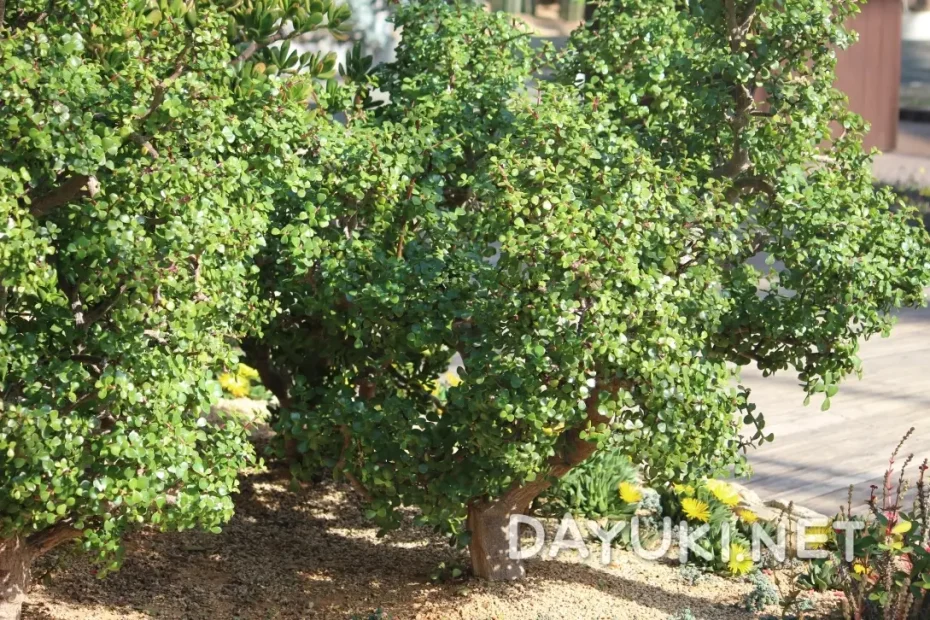
This beautiful succulent belongs to the genus Portulacaria and bears a striking resemblance to Crassula ovata (commonly known as the Jade Plant).
Along with the Jade Plant and Gollum Jade, it stands out as one of the few exceptional succulents that can be beautifully trained and cultivated as a long-lived indoor tree or bonsai. Globally, it is affectionately known by its famous nicknames, “Elephant Bush” or “Elephant Food.”
In Korea, it is traditionally called “Eun-haeng-mok” (meaning Ginkgo Tree Wood), a name that hints at its incredible growth potential. As it matures, this resilient succulent can grow up to a massive 4.5 meters (15 feet) tall, developing a robust, tree-like woody trunk.
Leaves
Small, thin, round green leaves with wider spacing than Crassula ovata (Jade Plant). This beautiful succulent belongs to the genus Portulacaria and bears a striking resemblance to Crassula ovata (commonly known as the Jade Plant). Like the Jade Plant, it features small, round green leaves clusters along its stems.
However, it has distinct identification features that set it apart: its leaves are significantly smaller, noticeably thinner, and grow with wider spacing along the branches.
Color & Flower
Another unique trait is its color stability—the vibrant green hues of the leaves remain consistent throughout the seasons without dramatic color shifts.
Additionally, it produces beautiful, delicate pink flowers.